T.A.L.O.S. DEEP DIVE
TEMPORAL ANALYSIS & LATENT OPTIMIZATION SYSTEM — how the four-pillar readiness engine actually works, and the published research behind every number on your gauge.
The composite score
TALOS synthesizes four physiological signals — Training Load, Recovery, Fuel, and Stress & Resilience — into one composite readiness score that updates after every check-in, workout, meal, or recovery event. Each pillar carries its own gauge, daily coaching directive, and 3-day forecast. The composite is a weighted blend of the four pillar scores, calibrated against your individual baseline.
Below each pillar section you’ll find the published research methodology TALOS uses to interpret your data. SENTINEL FORGE is not a medical device. AI-generated coaching directives are not medical advice — they are informed recommendations grounded in peer-reviewed sports-science literature. Always consult a qualified healthcare professional for medical questions.
Jump to: Training Load · Recovery · Fuel · Stress & Resilience · Time-window views
Training Load — Am I training optimally?
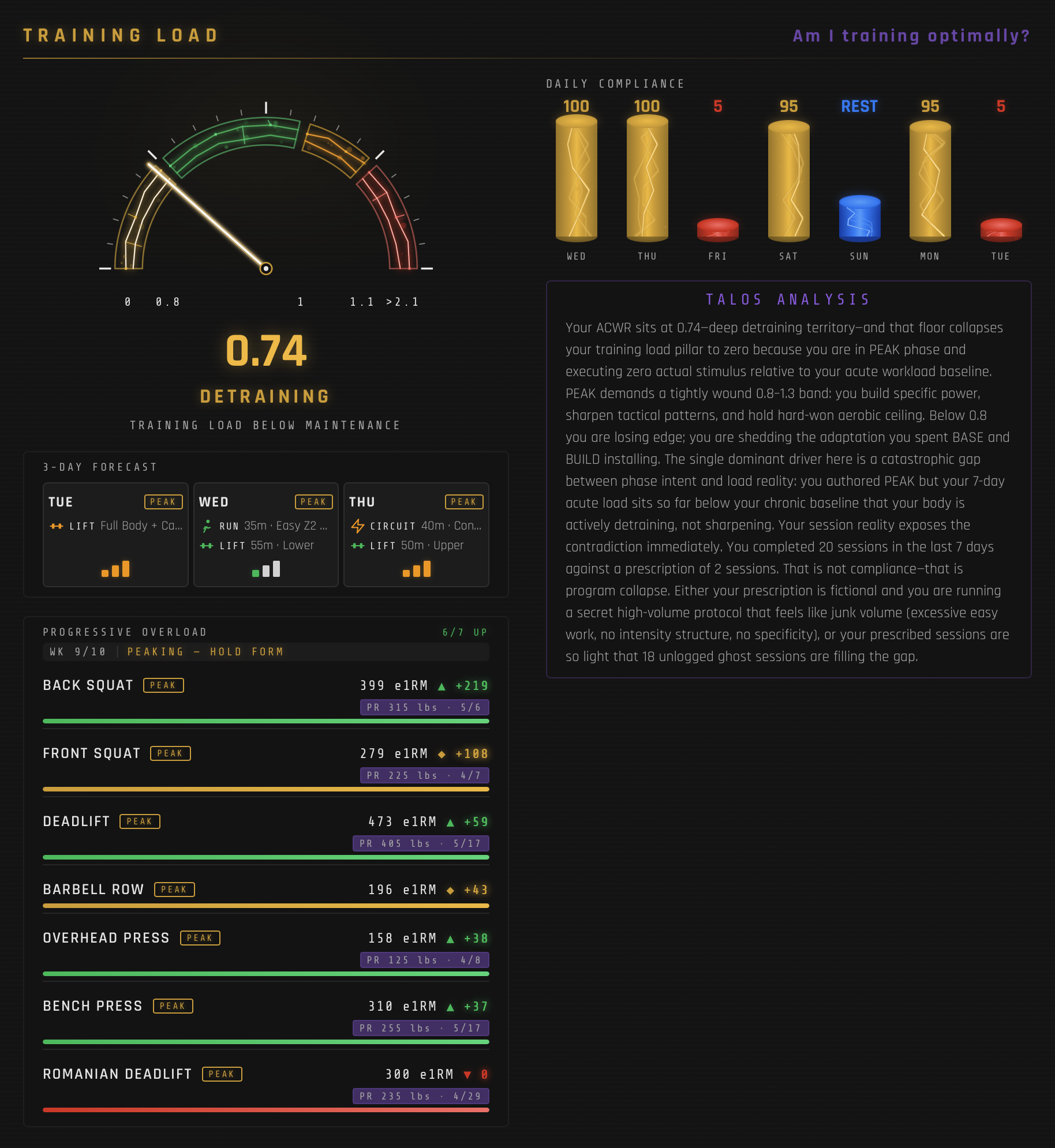
Training Load is anchored on the Acute:Chronic Workload Ratio (ACWR) — a 7-day rolling average of training load divided by a 28-day rolling average. Values between 0.8 and 1.3 represent the productive training band; below 0.8 indicates detraining (you’re losing fitness); above 1.5 indicates functional overreach and rising injury risk.
Load itself is computed via a 5-branch priority chain — whichever input produces the strongest signal wins:
- Sensor strain (Whoop) × 10 — gold-standard cardiovascular metric
- HR-zone TRIMP (Banister-weighted) — rescues Garmin/Polar/Apple Watch users
- Distance × sport-specific factor — objective input for endurance work
- Strength volume in pounds ÷ 500 — tonnage signal for lifters
- Duration × intensity × tier-multiplier — time-only fallback
Banister TRIMP weights HR zones: z1 × 1.0, z2 × 1.5, z3 × 2.5, z4 × 4.0, z5 × 5.5. The MAX-across-branches approach ensures supersetted lifting and long easy cardio both get the right load signal, regardless of which wearable you use.
Methodology & sources
- Gabbett TJ. The training-injury prevention paradox: should athletes be training smarter and harder? Br J Sports Med 2016;50:273–280. View paper: The training-injury prevention paradox: should athletes be training smarter and harder? →
- Banister EW. Modeling elite athletic performance. In: MacDougall JD, Wenger HA, Green HJ, editors. Physiological Testing of Elite Athletes. Champaign, IL: Human Kinetics; 1991:403–424.
- Hulin BT, Gabbett TJ, et al. The acute:chronic workload ratio predicts injury: high chronic workload may decrease injury risk in elite rugby league players. Br J Sports Med 2016;50:231–236. View paper: The acute:chronic workload ratio predicts injury: high chronic workload may decrease injury risk in elite rugby league players →
Recovery — Is my body ready for more?
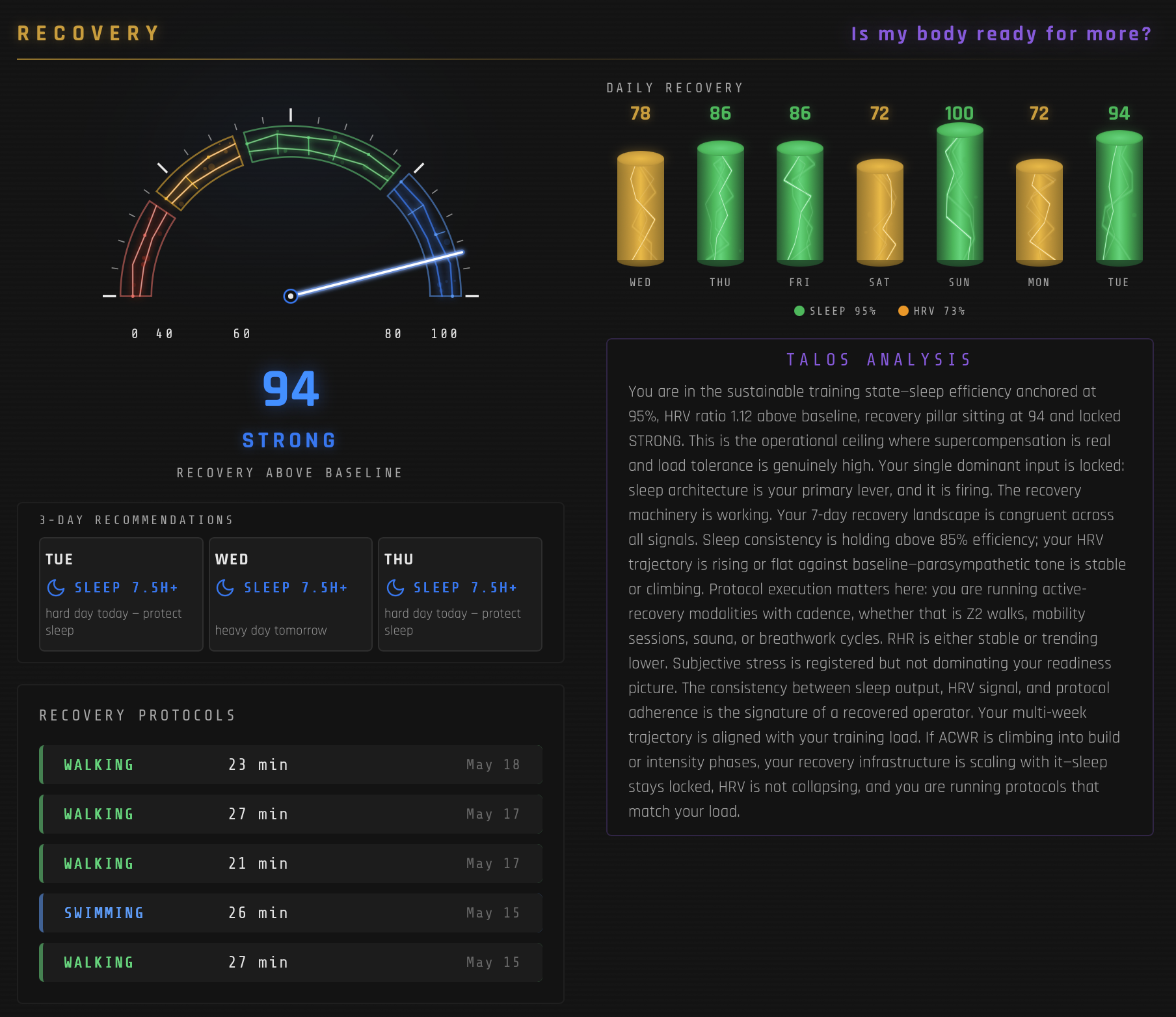
Recovery synthesizes three physiological signals against your individual baseline: heart-rate variability (HRV), sleep architecture, and active recovery activity. Scored on a 0–100 scale where 85+ indicates supercompensation-ready, 50–85 is sustainable training state, and below 50 is parasympathetic deficit territory requiring protocol intervention.
HRV is interpreted against your own baseline rather than population norms — an exponentially weighted average that settles over roughly 30 nights and is only trusted after 21 eligible nights. Each reading is scored as a fraction of that baseline: roughly 0.95–1.15× reads as balanced, below 0.80× as very low, and the low bands raise a recovery flag regardless of the absolute number. Sleep is weighted across total duration, sleep efficiency (time asleep ÷ time in bed), and stage distribution (deep + REM as % of total sleep). Active recovery activity (walks, mobility, breathwork) compounds positively toward the score.
Recovery protocols (the daily recommendations under the gauge) are selected algorithmically from a catalog of evidence-based modalities — sleep extension, zone-1 cardio, mobility, sauna, breathwork — ranked by their applicability to your specific deficit pattern.
Methodology & sources
- Buchheit M. Monitoring training status with HR measures: do all roads lead to Rome? Frontiers in Physiology 2014;5:73. View paper: Monitoring training status with HR measures: do all roads lead to Rome? →
- Stanley J, Peake JM, Buchheit M. Cardiac parasympathetic reactivation following exercise: implications for training prescription. Sports Med 2013;43:1259–1277. View paper: Cardiac parasympathetic reactivation following exercise: implications for training prescription →
- Hirshkowitz M, Whiton K, Albert SM, et al. National Sleep Foundation’s sleep time duration recommendations: methodology and results summary. Sleep Health 2015;1:40–43. View paper: National Sleep Foundation’s sleep time duration recommendations: methodology and results summary →
- Walker MP. The role of sleep in cognition and emotion. Annals of the New York Academy of Sciences 2009;1156:168–197. View paper: The role of sleep in cognition and emotion →
Fuel — Am I supporting performance?
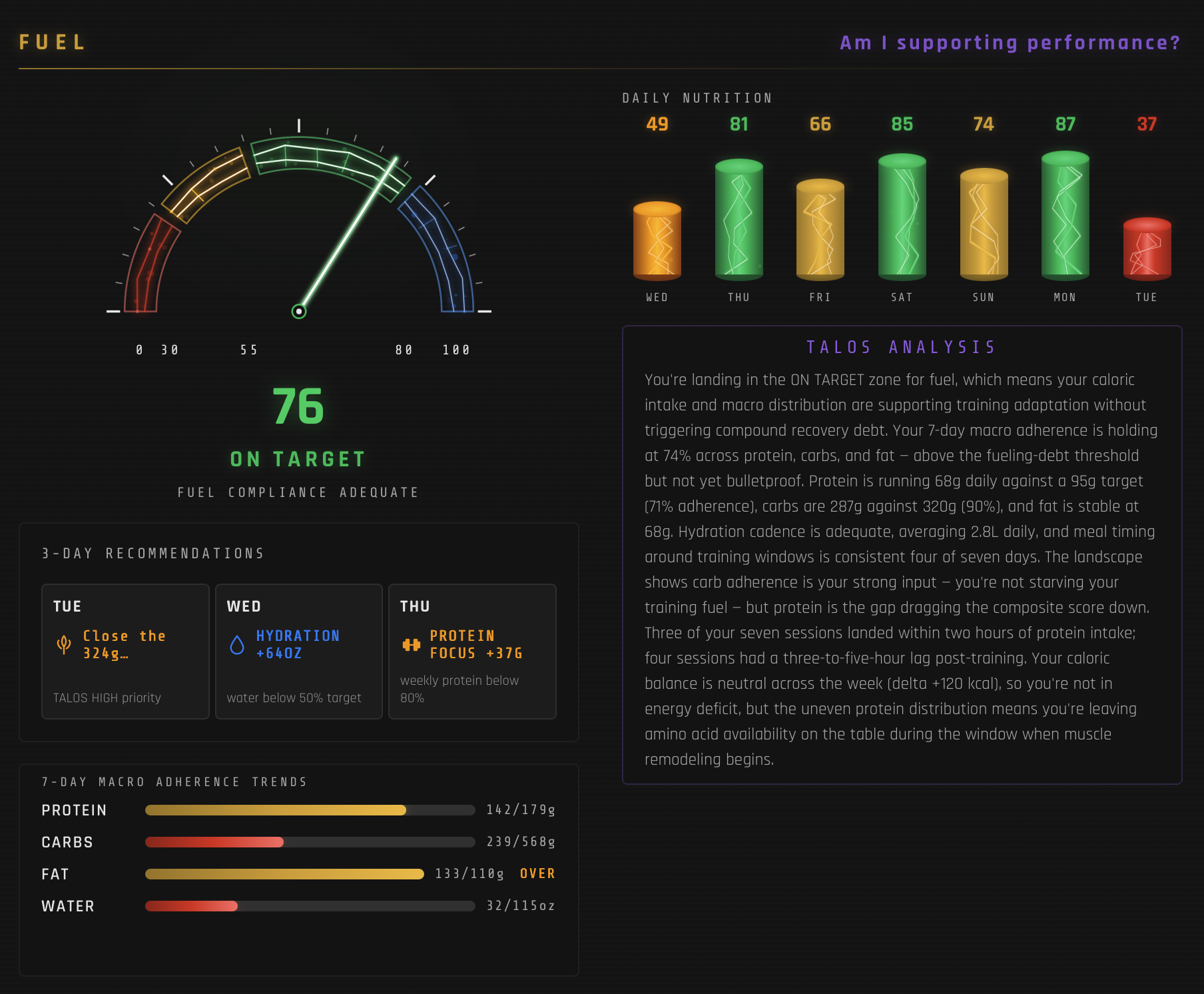
Fuel scores macronutrient adherence and calorie alignment against your daily targets. Your baseline is computed via the Katch-McArdle equation when we know your body-fat percentage, and the Mifflin-St Jeor equation otherwise, then multiplied by your operational tempo (garrison through sustained combat) and adjusted by your stated goal.
Macro targets are set from your body mass and your goal:
- Protein — 0.8–1.2 g per pound of body mass, set by your goal (highest on a cut, to protect lean mass)
- Fat — 25% of your calorie target, 30% on a cut
- Carbohydrate — the balance of your calorie target after protein and fat, with a 10% uplift in the late-luteal phase for operators tracking a cycle
The Fuel score weights protein 40%, carbohydrate 25%, fat 20% and hydration 15% against those targets. Early in the day it leans on your rolling baseline from the past week and shifts toward today’s logging as the day fills in, so a pre-breakfast reading does not sink the pillar; by late evening it reflects today alone. The baseline needs at least three logged days in the past week — until then, the score is today only.
Methodology & sources
- Mifflin MD, St Jeor ST, Hill LA, Scott BJ, Daugherty SA, Koh YO. A new predictive equation for resting energy expenditure in healthy individuals. Am J Clin Nutr 1990;51:241–247. View paper: A new predictive equation for resting energy expenditure in healthy individuals →
- Phillips SM, Van Loon LJ. Dietary protein for athletes: from requirements to optimum adaptation. J Sports Sci 2011;29 Suppl 1:S29–S38. View paper: Dietary protein for athletes: from requirements to optimum adaptation →
- Aragon AA, Schoenfeld BJ. Nutrient timing revisited: is there a post-exercise anabolic window? J Int Soc Sports Nutr 2013;10:5. View paper: Nutrient timing revisited: is there a post-exercise anabolic window? →
- Burke LM, Hawley JA, Wong SH, Jeukendrup AE. Carbohydrates for training and competition. J Sports Sci 2011;29 Suppl 1:S17–S27. View paper: Carbohydrates for training and competition →
Stress & Resilience — What is my total load?
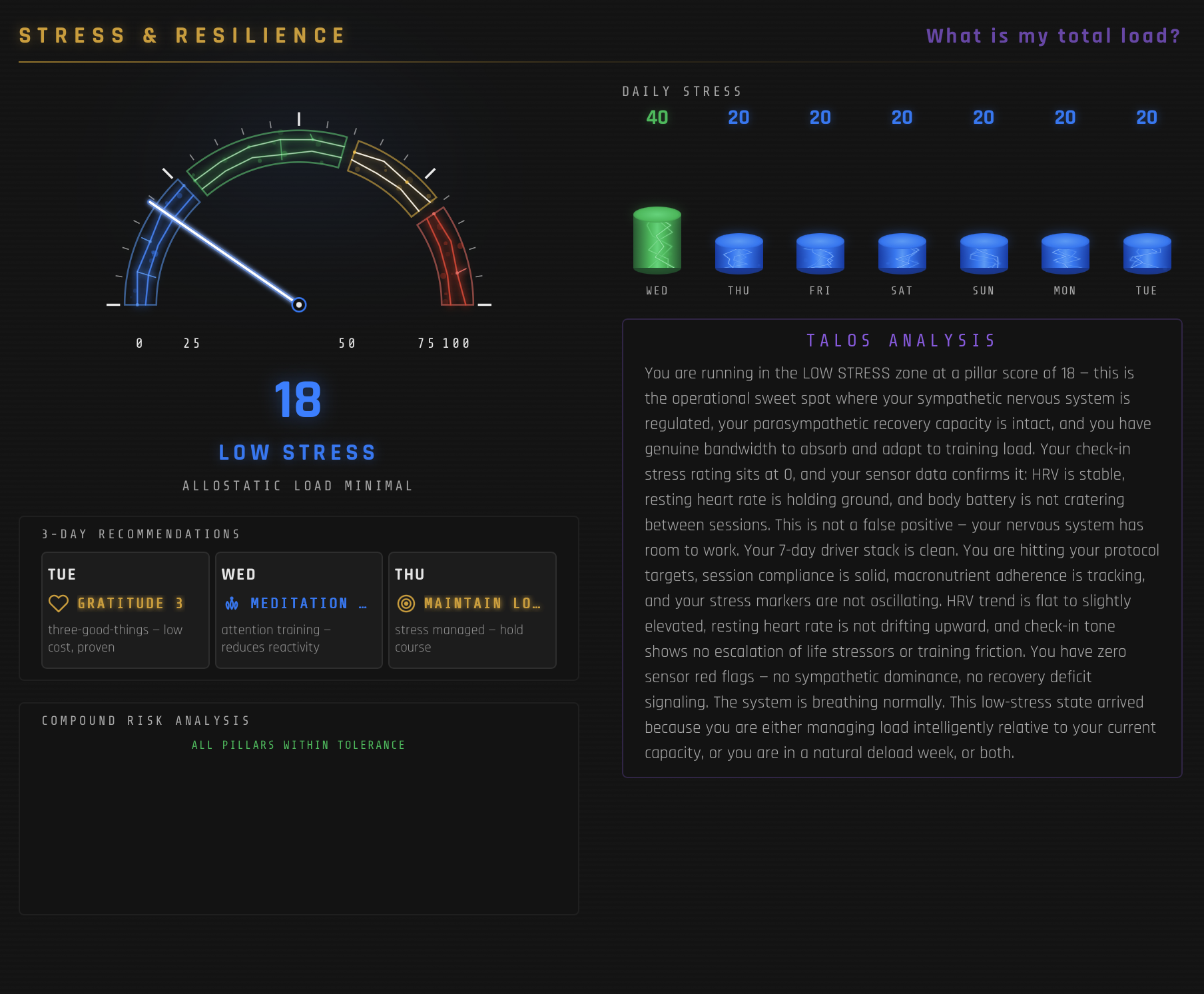
Stress & Resilience tracks allostatic load — the cumulative wear-and-tear on the body from training stressors, life stressors, and recovery adequacy. It correlates your self-reported stress check-ins against objective HRV signal and resting heart rate trends to surface mismatches: high reported stress with normal HRV (psychological — meditation, gratitude protocols indicated) vs. low reported stress with elevated RHR (subclinical physical stress accumulation — deload indicated).
Scored on a 0–100 scale where 0–25 is LOW STRESS (operational sweet spot), 26–50 is moderate, 51–75 is high, and 76+ is critical — sympathetic dominance has overridden parasympathetic recovery. The Compound Risk Analysis under the gauge surfaces when multiple pillars are simultaneously outside tolerance, which compounds injury and burnout risk multiplicatively rather than additively.
Recommendations are selected for the specific risk pattern: gratitude protocols for psychological dominance, meditation and breathwork for sympathetic overactivation, deload and sleep extension for physical accumulation.
Methodology & sources
- McEwen BS. Stress, adaptation, and disease: allostasis and allostatic load. Annals of the New York Academy of Sciences 1998;840:33–44. View paper: Stress, adaptation, and disease: allostasis and allostatic load →
- Thayer JF, Ahs F, Fredrikson M, Sollers JJ, Wager TD. A meta-analysis of heart rate variability and neuroimaging studies: implications for heart rate variability as a marker of stress and health. Neurosci Biobehav Rev 2012;36:747–756. View paper: A meta-analysis of heart rate variability and neuroimaging studies: implications for heart rate variability as a marker of stress and health →
- Kim HG, Cheon EJ, Bai DS, Lee YH, Koo BH. Stress and heart rate variability: a meta-analysis and review of the literature. Psychiatry Investigation 2018;15:235–245. View paper: Stress and heart rate variability: a meta-analysis and review of the literature →
Beyond the daily snapshot
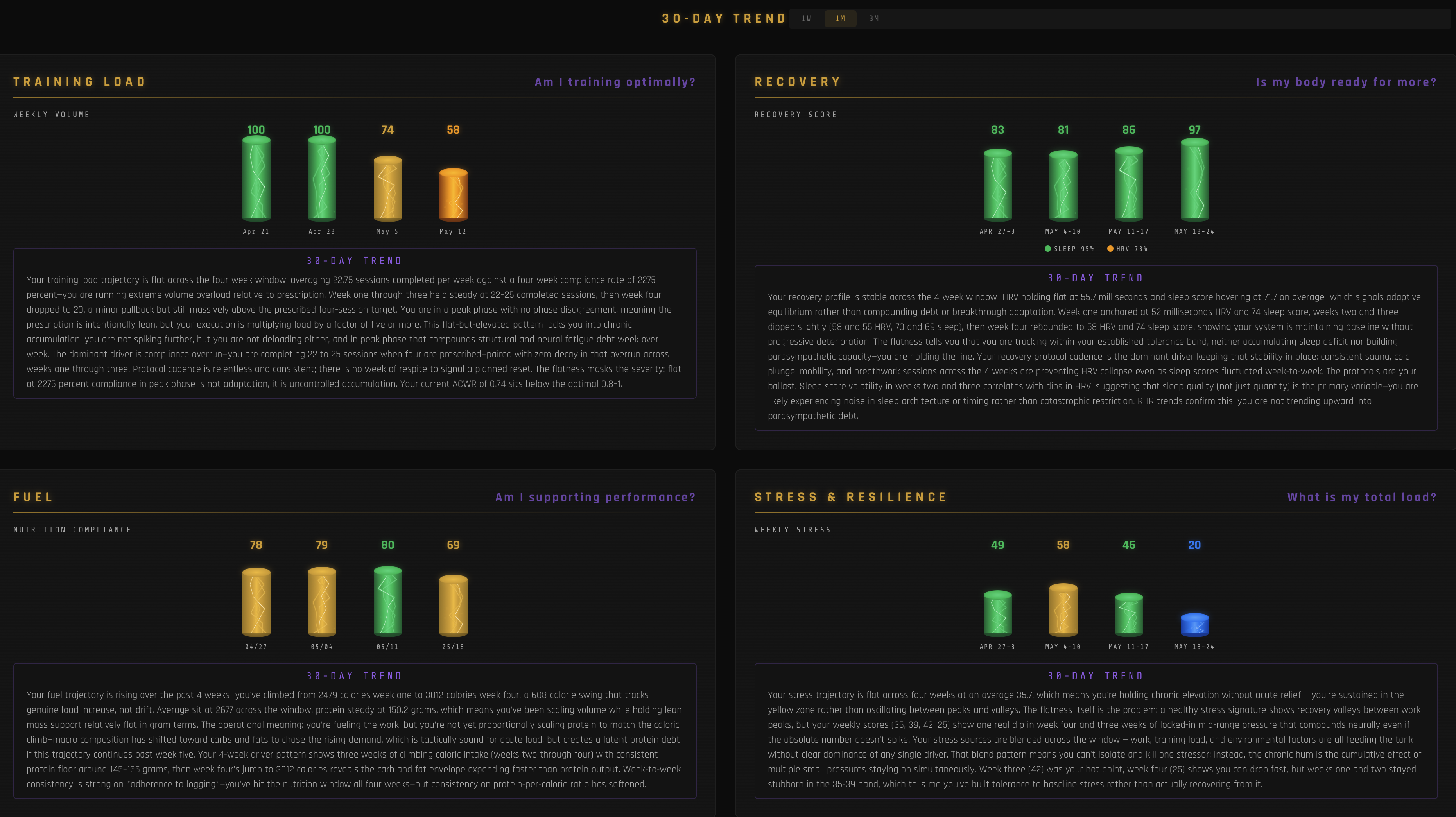
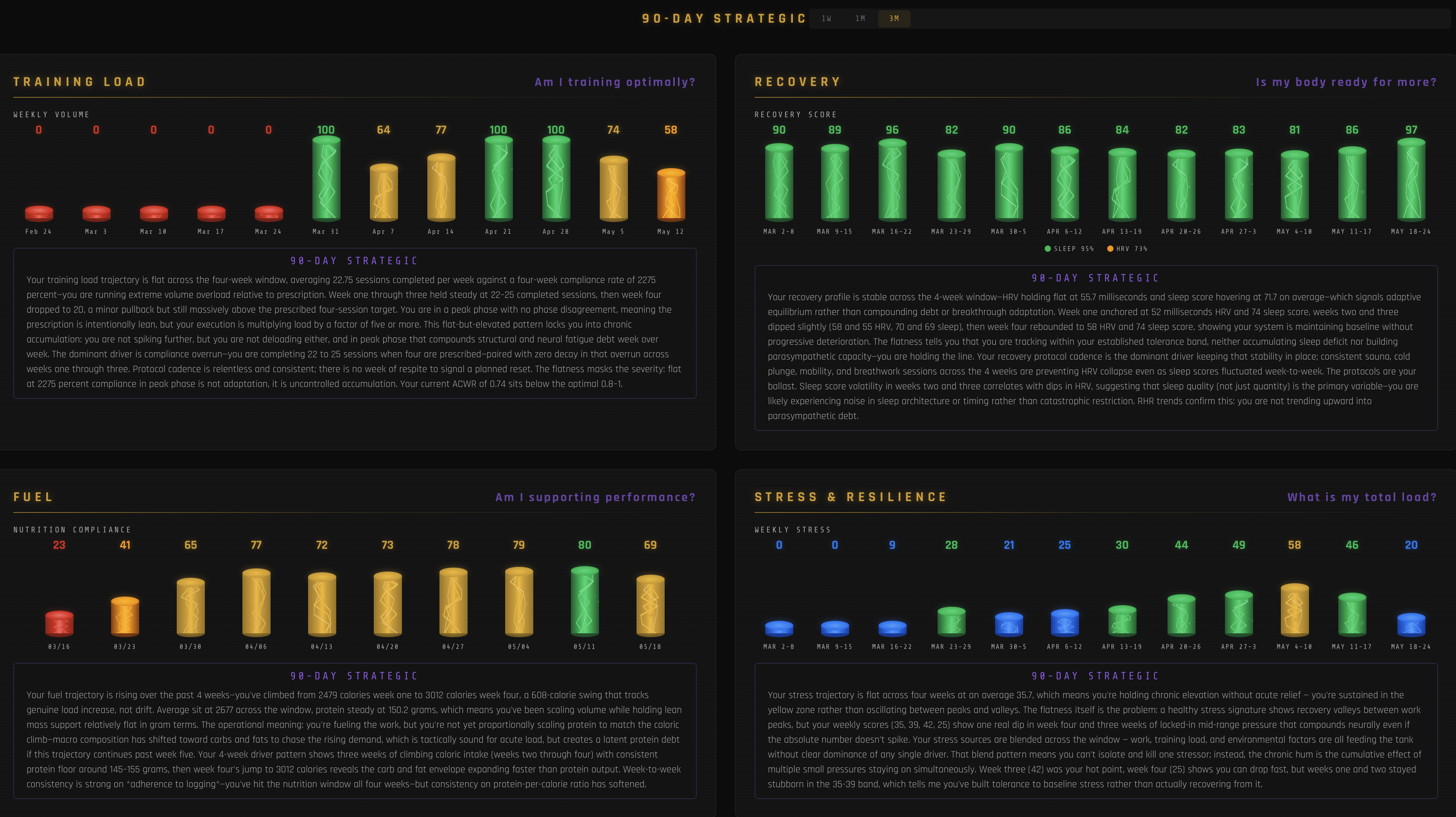
Pillar gauges give you today’s state — but the same pillars roll up into trend views that surface the slow-moving patterns daily metrics can hide. The 30-day trend exposes weekly cycles; the 90-day strategic view exposes mesocycle phases and macrocycle drift.
30-day trend
Weekly granularity across all four pillars. Useful for spotting whether a single bad week is a blip or the leading edge of a deload-needed pattern. Color-coding matches the daily gauges so a 30-day glance gives you the same signal language as today’s screen.
90-day strategic
Monthly granularity across the same four pillars. Designed for periodization-aware users planning training blocks, race builds, or cuts/bulks. The 90-day window surfaces drift that’s invisible at the daily and weekly scales — chronic baseline shifts, recovery debt accumulating across a build, and the adaptive vs. maladaptive phase distinctions athletic coaches actually plan against.
Not medical advice
SENTINEL FORGE is a fitness and training optimization platform. TALOS, the recommendations it surfaces, and the AI-generated coaching content are not medical advice and are not intended to diagnose, treat, cure, or prevent any disease. The published research above informs our methodology — it does not transfer medical authority to the app. Consult a qualified healthcare professional, registered dietitian, or licensed coach for medical questions or before making material changes to your training, nutrition, or recovery regimen.
Questions about TALOS methodology, data sources, or how a specific metric is computed? Contact us →